The Ambiguous Cube
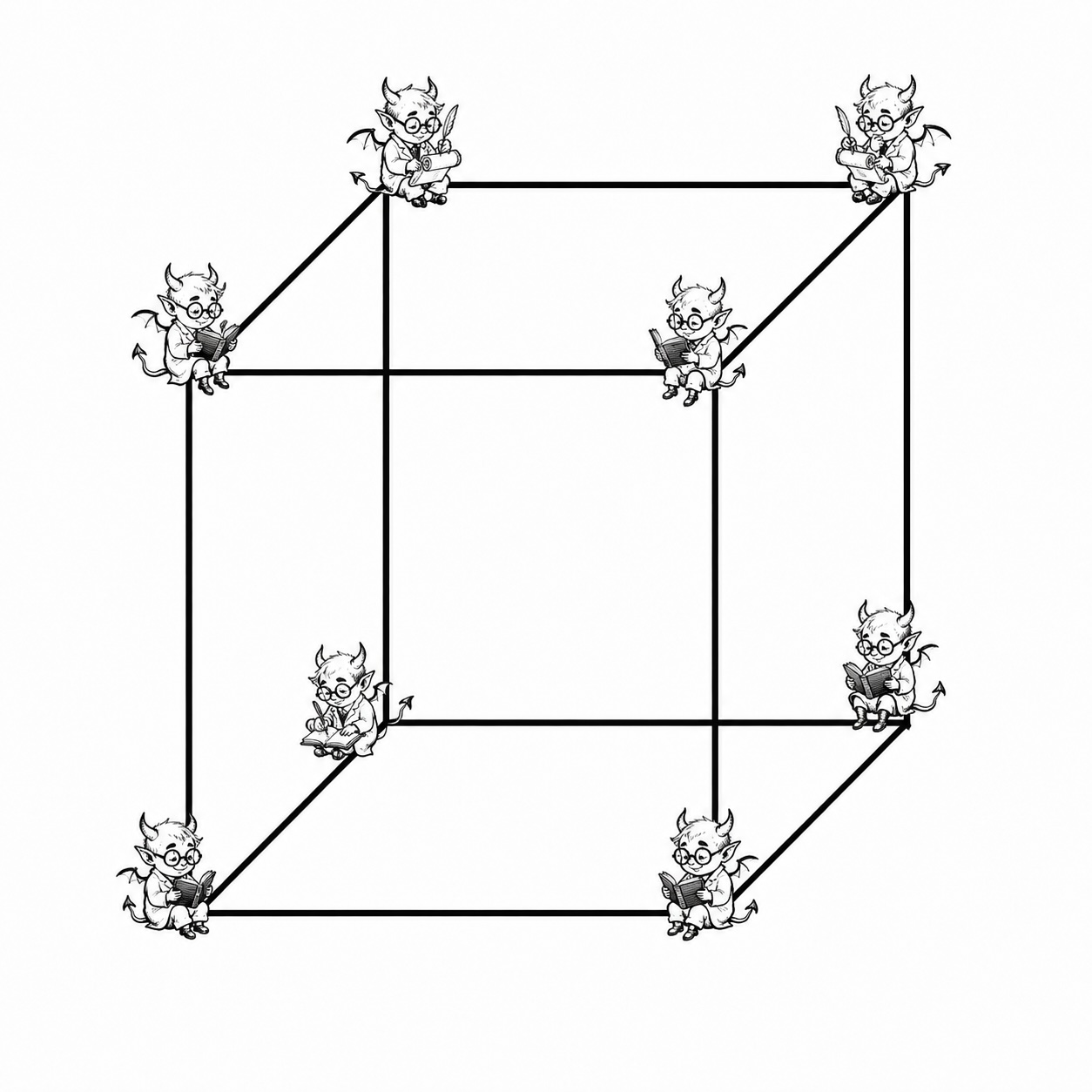
This demonstration uses a modified Necker Cube. Spend a short time observing the image and note what happens to your experience of it. The drawing itself stays the same throughout, but your perception may not.
What to do
- Press Start observation to begin a 30-second viewing period.
- Each time the cube seems to change its 3D orientation, press I saw it flip.
- You can also press the space bar instead of clicking.
Live session
Why the demons matter
The little demons act like anchors at the cube's vertices. They make the ambiguous structure easier to think about: when the cube flips, the demons' implied positions in space flip as well, even though nothing on the page has moved.
Your observation
You reported 0 perceptual flips during the viewing period.
If you experienced any reversals, you have just witnessed a classic feature of perceptual organisation: the visual system can alternate between two different 3D interpretations of the same unchanging 2D image.
Why this matters
The Necker Cube is a powerful reminder that perception is not a simple readout of the retinal image. The sensory input here is underdetermined: the lines on the page are compatible with more than one spatial arrangement. Your visual system therefore has to organise the image into a coherent world, and it can do so in more than one way.
In this version, the demons make the ambiguity especially vivid. Because they sit at the vertices and remain the same objective size, they both decorate the cube and subtly interfere with ordinary depth expectations. They help reveal that perceptual experience is an achievement of interpretation, not just a copy of input.
You can run the demo again as many times as you like. Some observers experience repeated flips, some very few, and some can encourage one interpretation by attending to a particular face or corner.