
01
The lamppost and the clouds
Why did the lamppost seem to fall when the clouds moved behind it?

Attention, expectation, prediction, and the science of conscious perception.
How does the brain construct a conscious world from attention, expectation, and sensory evidence?
This site is for anyone who has ever wondered how the world becomes experience. It is for perception scientists and students, but also for children, artists, philosophers, and curious adults who have asked questions such as: Why do I see colour? How can I miss something right in front of me? How does the brain construct a world? What is consciousness? The essays, demonstrations, research summaries, and theoretical reflections collected here are invitations to look again at ordinary experience and find it extraordinary.
I am a cognitive scientist investigating how attention, expectation, prediction, and inference shape conscious experience. My research combines behavioural experiments, psychophysics, EEG/ERP-informed methods, predictive processing, and theoretical approaches to awareness and worldhood.
I am a Lecturer in Cognitive Psychology in the School of Human and Social Sciences at the University of West London. At UWL, I lead a research programme on attention, expectation, prediction, and conscious perception, working with my doctoral students on projects examining the interplay between attention and expectation in constructing experience, neural signatures of face perception, auditory and haptic expectation, visual acceleration, optic flow, visual gravity, and perceived duration.
Before joining UWL, I was a Visiting Assistant Professor in the Psychology Department at State University of New York, Farmingdale State College, and held teaching and research positions at The Cooper Union for the Advancement of Science and Art, The New School for Social Research, William Paterson University, New York City College/CUNY, and the W.E.B. Du Bois Scholars Institute, hosted at Princeton University.
I completed my PhD in Cognitive Psychology at the New School for Social Research with Arien Mack, Marcel Kinsbourne, and William Hirst, where my work was shaped by traditions in attention, perception, neuropsychology, memory, and consciousness. I also completed an MA in Psychology at the New School for Social Research with Arien Mack, and a BA (Hons) in Ancient World Studies at University College London. At UCL, I studied ancient Greek philosophy in seminars with Dr Robert W. Sharples, reading and discussing figures including the Presocratics, Heraclitus, Parmenides, Democritus, Plato, Aristotle, and Plotinus. Dr Sharples’s work in ancient philosophy, natural philosophy, and the Aristotelian tradition remains an important part of the intellectual background to my current theoretical interests.
My research asks how experience is constructed: when awareness depends on attention, how expectations shape perception, and whether expectations can sometimes generate reports of experience in the absence of a corresponding stimulus. I use behavioural, psychophysical, online, and EEG/ERP methods, and develop theoretical links with predictive processing, active inference, the Free Energy Principle, and Awareness-First Theory.
My research on attention, expectation, and conscious perception developed in part through my earlier work with Arien Mack and the Mack Perception Lab at The New School for Social Research, an important intellectual home for my work on inattentional blindness and the relationship between attention and perception. My current theoretical work also draws on my earlier formation in ancient philosophy, especially questions concerning the nature of reality, appearance, mind, matter, ontology, and the relation between what appears and what is.
My teaching spans sensation and perception, cognitive psychology, cognitive neuroscience, neuropsychology, statistics, and quantitative research methods. Across these areas, I aim to help students understand how mind, brain, behaviour, and experience can be studied scientifically, while also encouraging them to think deeply about perception, consciousness, and the construction of reality.
Some of the questions that now guide my research began long before I had the language of perception science, predictive processing, or consciousness studies. They began as childhood puzzles about motion, appearance, awareness, and existence.
Why did the lamppost seem to fall when the clouds moved behind it?
Why did I still feel motion after I had stopped spinning?

Why does any of this exist at all?

Across my empirical and theoretical work, I return to a small set of connected questions about how conscious experience is constructed.
When does sensory information become consciously available?
Can expectation generate conscious reports when an expected stimulus is absent?
How do priors, precision, and action shape what a perceiver experiences?
What if awareness is the field in which bodies, minds, and worlds appear?
These figures summarise the core idea running through my empirical and theoretical work: conscious perception is constructed through the interaction of ambiguous sensory input, prior expectations, prediction errors, and attentional precision.
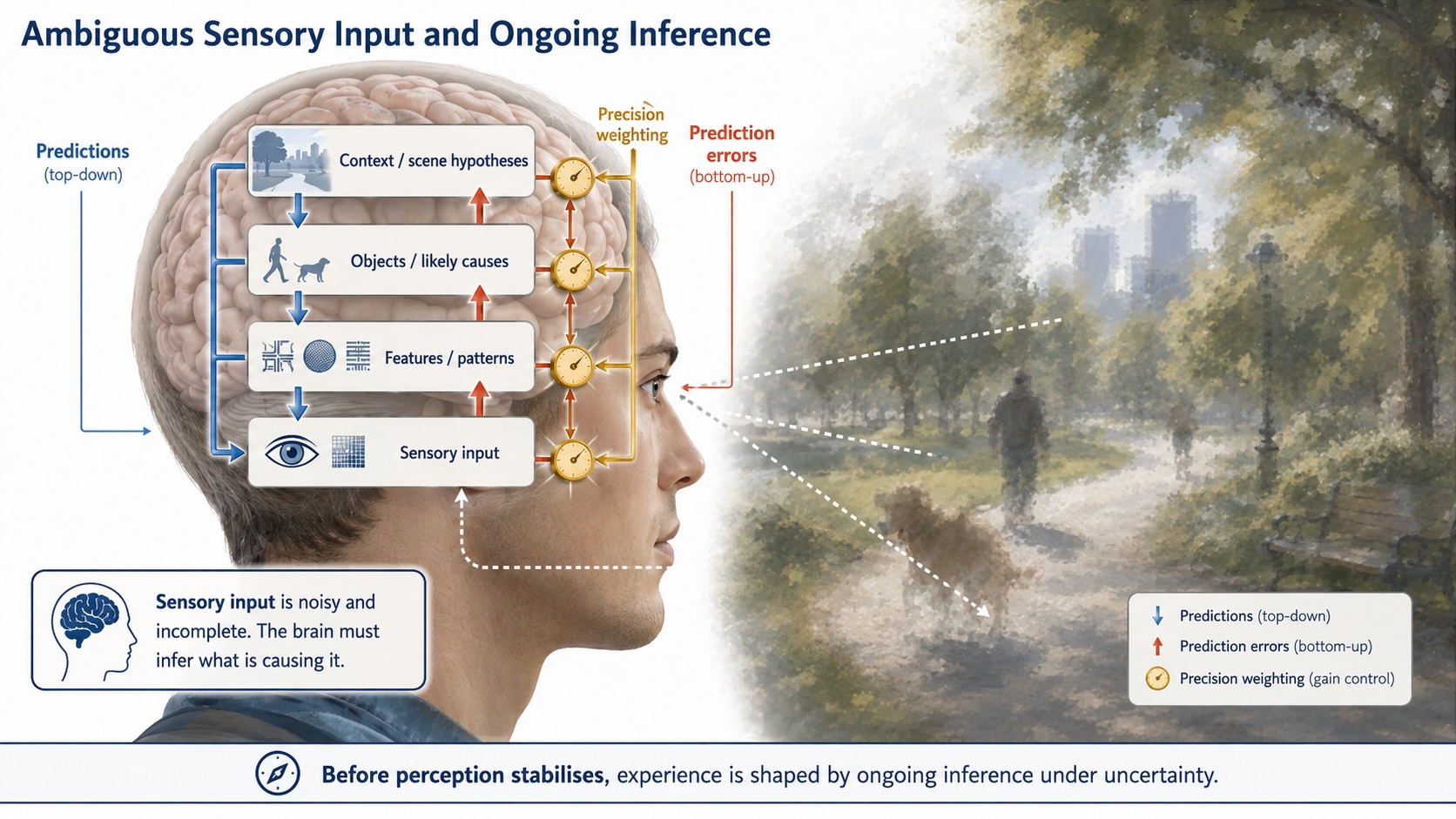
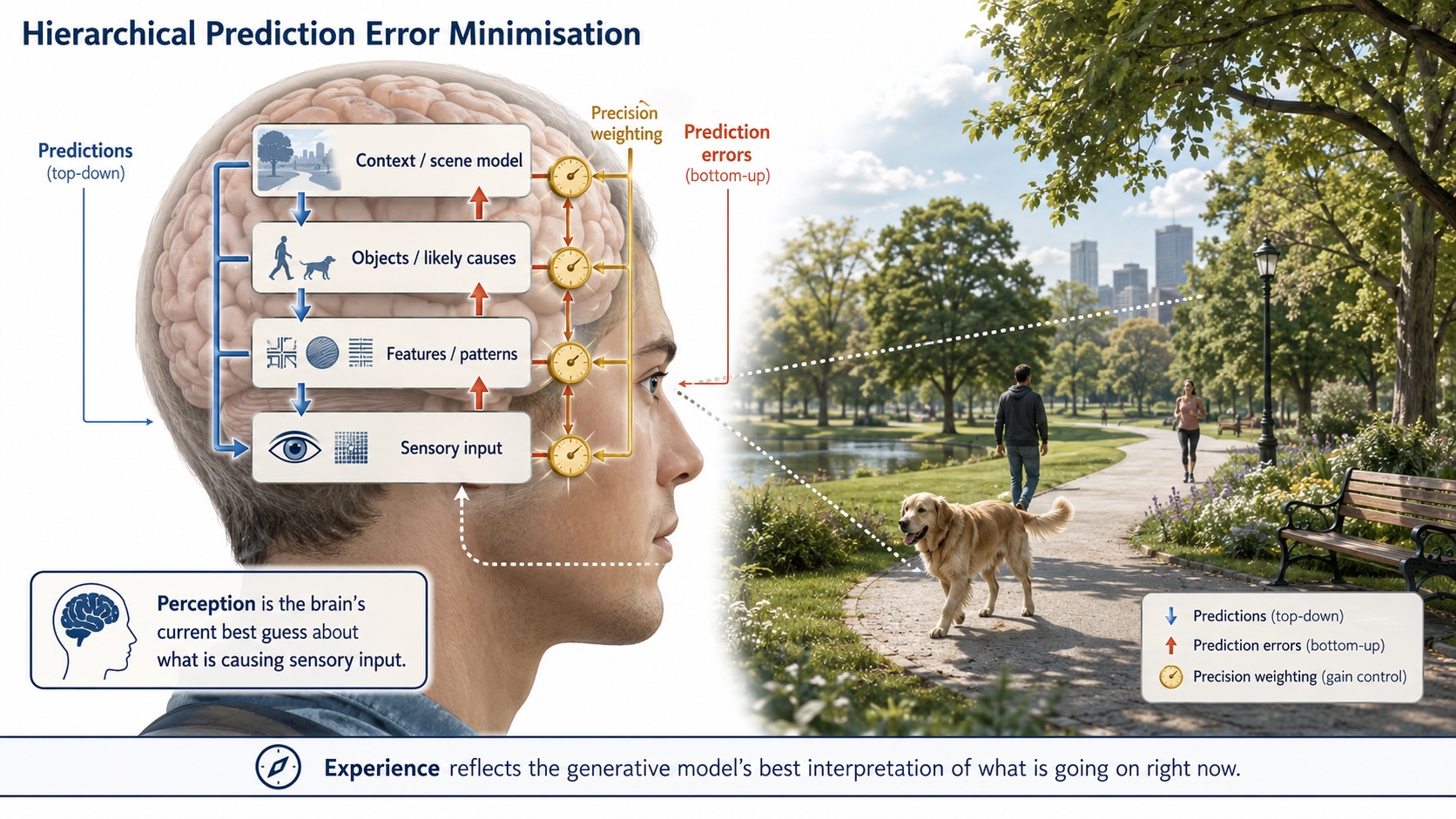
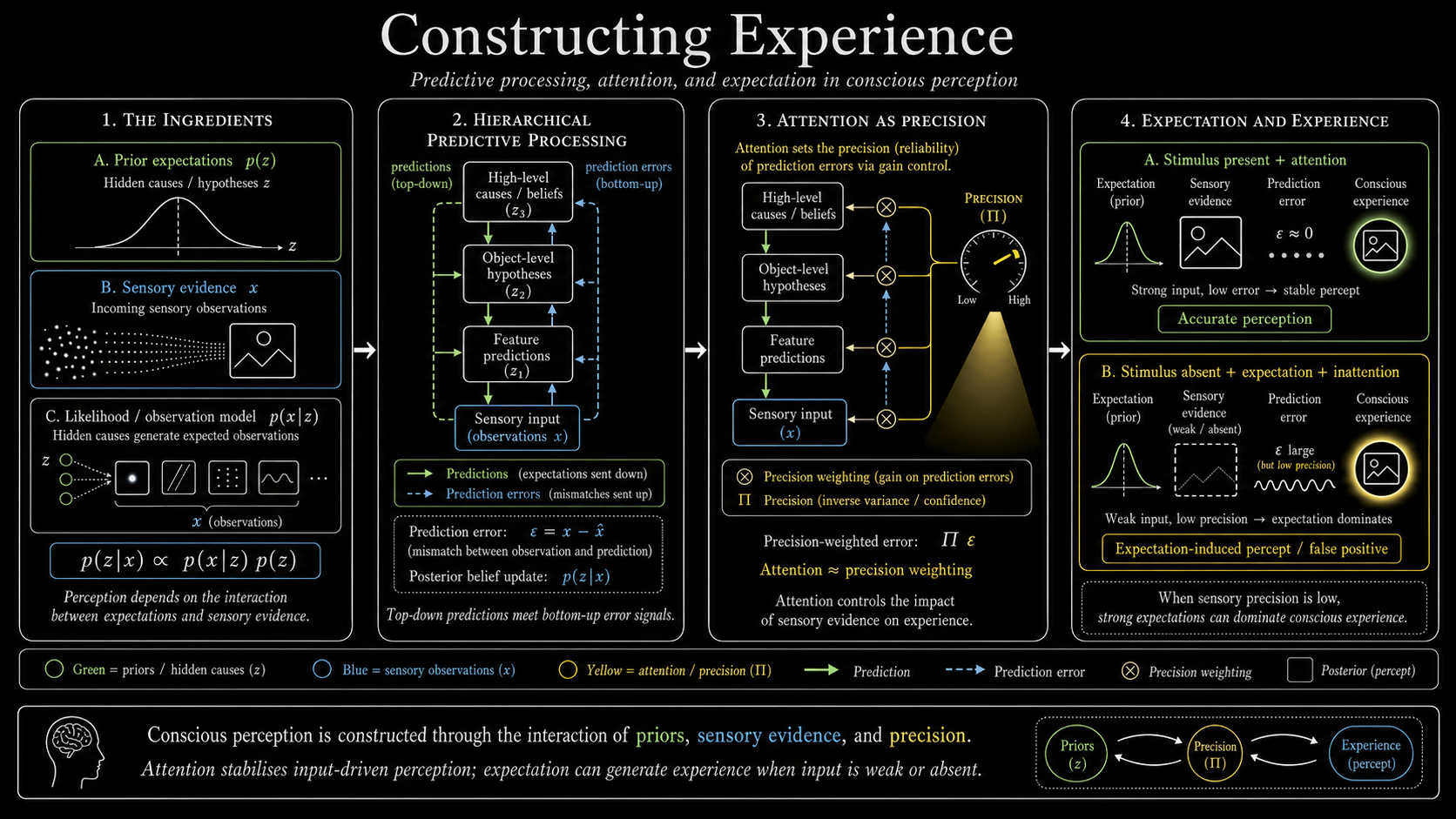
Using behavioural, psychophysical, and EEG/ERP-informed methods, I investigate how attentional selection, prior expectation, sensory evidence, scene meaning, temporal perception, and conscious report interact in the construction of experience.
Inattentional blindness, change blindness, iconic memory, and scene awareness
Studies examining what becomes conscious when attention is occupied or diverted, including work on natural scenes, objects, semantic incongruity, visual awareness, and iconic memory.
Absent but expected stimuli under conditions of inattention
A sequence of experiments testing whether observers report consciously experiencing expected stimuli that are absent on critical trials, including letters, colour patches, faces, sounds, and touch.
Duration perception, entropy, optic flow, visual acceleration, and visual gravity
Research on how violations of expected structure and physical regularities influence perceived duration and the organisation of perceptual experience.
In my theoretical work, I use these empirical findings on attention and expectation to address broader questions about predictive processing, active inference, the Free Energy Principle, and the ontological status of awareness.
Perception is understood as precision-weighted inference. Attention changes the influence of sensory evidence; expectation constrains what is likely to appear.
AFT asks whether awareness is not produced inside a mindless physical universe, but is the field within which bodies, worlds, measurements, and explanations appear.
These short public-facing essays explore how experience is constructed. They begin with ordinary moments — seeing colour, motion, depth, objects, faces, shadows, and changes — and use them as gateways into perception science, cognitive neuroscience, predictive processing, and philosophy.
This section is conceived as an accessible series for students, teachers, young readers, and curious adults. The essays are connected to my scientific and philosophical work, but are written as invitations into the questions rather than as peer-reviewed research articles.
Featured essay
Perception, frames, and the construction of reality: a reflective essay on how a shift in reference frame can transform the experienced world, from the movement of the Milky Way to the deeper question of how perception constructs reality.
Essays that begin with lived experience and ask what science reveals about how a world is visually and phenomenologically constructed.
Essays that connect perceptual experience to larger philosophical questions about mind, world, appearance, and what science leaves out when it abstracts from lived experience.
Brief essays designed to accompany the interactive demonstrations on the site, linking direct experience with explanation and reflection.
These browser-based demonstrations are designed for teaching, talks, open days, and public engagement. They invite visitors to try short perceptual tasks and then reflect on what the task reveals about attention, expectation, prediction, and conscious experience. They are not formal experiments or validated measures of individual performance.
I will add further demonstrations here as they are developed.
A short continuous scene demonstration
Try a brief visual task in which you watch a scene and keep track of a simple event. After you respond, the demonstration gives feedback and explains what the task can show about human perception.
A brief expectation-based perception demonstration
Try a short visual task involving rapid pattern judgements and a final report. After you respond, the demonstration gives feedback and explains the logic of the task.
A short visual interpretation demonstration
Try a brief task in which you describe an object as it appears in different visual scenes. After you respond, the demonstration gives feedback and explains what the task can show about visual interpretation.
A brief apparent-motion demonstration
Try a simple display in which two visual events alternate in time. After you respond, the demonstration explains what the task can show about perceived motion.
A motion-aftereffect demonstration
Watch a rotating pattern, then look at a still village-green scene. After you respond, the demonstration explains how motion can briefly appear to persist after physical motion has stopped.
A reversible-figure demonstration
View a classic line drawing and track how its apparent depth changes over time. After you respond, the demonstration offers a short explanation of what the display can show about visual organisation and conscious experience.
A Bayesian inference and inverse-problem demonstration
Step through a guided demonstration in which a being inside a sealed room hears an ambiguous sound and must infer its hidden cause. Explore how changing priors changes the posterior even when the sensory evidence stays the same.
An active inference and Markov blanket demonstration
Enter a guided underwater demonstration in which a submarine receives ambiguous sensory signals, updates beliefs about hidden causes, and then acts to reduce uncertainty and remain in viable states.
A short motion and time-perception demonstration
Try a brief visual motion task involving optic-flow displays and duration judgements. After you respond, the demonstration explains the logic of the task.
My current doctoral students are extending the expectation-awareness and perceptual-expectation research programmes across sensory modalities, neural measures, and perceived time.
Expected absent faces, inattention, and face-sensitive processing
Doctoral work extending absent-face expectation experiments and examining evidence relevant to neural signatures of face-sensitive processing under expectation and inattention.
Perceiving the absent in audition
Doctoral research testing whether expected but absent auditory events can be consciously reported under conditions of inattention.
Expectation, touch, and bodily perception
Doctoral research extending the logic of expectation-driven conscious reports into tactile and bodily perception.
Optic flow, visual gravity, and time perception
Doctoral research examining how visual acceleration, optic flow, and gravity-like motion cues influence perceived duration and the organisation of perceptual experience.
My Cambridge Element develops the central argument that conscious perception is shaped by attention, expectation, prediction, and inference.
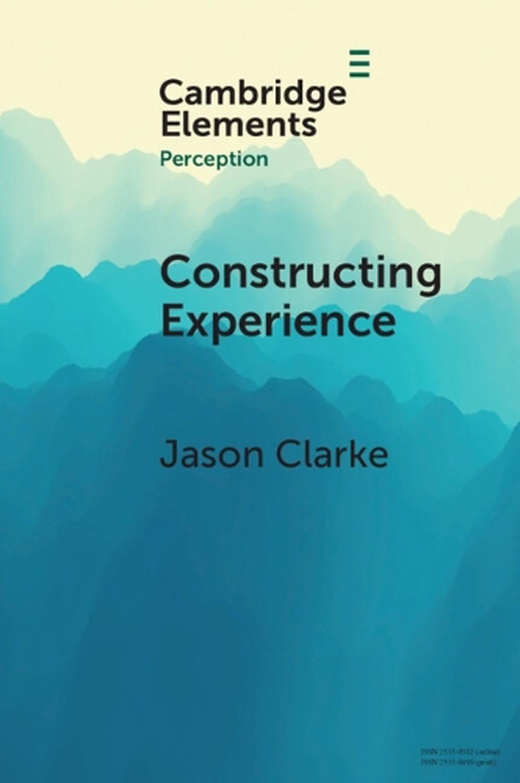
The book brings together work on inattentional blindness, iconic memory, expectation, predictive processing, and conscious perception to ask how experience is constructed.
A conversation about the brain as a predictive, generative system: how attention selects and weights sensory evidence, how expectations shape perceptual reality, and why expected but absent stimuli can sometimes be reported under conditions of inattention. The discussion also considers consciousness, the explanatory gap, controlled hallucination, and the clinical and theoretical implications of expectation-driven experience.
Selected books, peer-reviewed articles, published abstracts, and conference presentations on attention, expectation, conscious perception, predictive processing, time perception, and Awareness-First Theory.
Cambridge University Press, Elements in Perception.
doi.org/10.1017/9781009588577Entropy, 28(3), 306. Published in the Special Issue: Active Inference in Cognitive Neuroscience.
doi.org/10.3390/e28030306Timing & Time Perception.
doi.org/10.1163/22134468-bja10105Studia Psychologica, 62(4), 335–349.
doi.org/10.31577/sp.2020.04.808Timing & Time Perception, 8(3–4), 279–298.
doi.org/10.1163/22134468-bja10012Attention, Perception, & Psychophysics, 80(7), 1833–1846.
doi.org/10.3758/s13414-018-1558-zConsciousness and Cognition, 59, 60–63.
doi.org/10.1016/j.concog.2017.10.001Consciousness and Cognition, 48, 87–103.
doi.org/10.1016/j.concog.2016.10.010Consciousness and Cognition, 49, 363–364.
doi.org/10.1016/j.concog.2016.10.004Consciousness and Cognition, 40, 1–8.
doi.org/10.1016/j.concog.2015.12.006Visual Cognition, 23(7), 917–938.
doi.org/10.1080/13506285.2015.1103826Consciousness and Cognition, 35, 156–157.
doi.org/10.1016/j.concog.2015.05.009Consciousness and Cognition, 33, 291–299.
doi.org/10.1016/j.concog.2014.12.016Consciousness and Cognition, 30, 256–265.
doi.org/10.1016/j.concog.2014.09.015Visual Cognition, 20(3), 300–327.
doi.org/10.1080/13506285.2012.666578European Conference on Visual Perception (ECVP), Bournemouth, UK.
Auditory Science Meeting, Manchester, UK.
European Conference on Visual Perception (ECVP), Mainz, Germany.
doi.org/10.13140/RG.2.2.27732.46726British Neuroscience Association International Festival of Neuroscience, Liverpool, UK.
European Conference on Visual Perception.
Vision Sciences Society Annual Conference, Florida, USA.
Journal of Vision, 18(10), 1115.
doi.org/10.1167/18.10.1115OPAM: Object Perception, Visual Attention, and Visual Memory, Vancouver, Canada.
Perception 46 ECVP Abstract; European Conference on Visual Perception, Berlin, Germany.
Journal of Vision, 16(12), 40.
doi.org/10.1167/16.12.40Journal of Vision, 15(12), 348.
doi.org/10.1167/15.12.348Journal of Vision, 15(12), 441.
doi.org/10.1167/15.12.441Journal of Vision, 14(10), 609.
doi.org/10.1167/14.10.609Journal of Vision, 13(9), 1136.
doi.org/10.1167/13.9.1136Journal of Vision, 11(11), 156.
doi.org/10.1167/11.11.156Journal of Vision, 11(11), 1280.
doi.org/10.1167/11.11.1280I am open to conversations about research collaboration, doctoral supervision, media enquiries, talks, and work relating to attention, expectation, prediction, perception, consciousness, active inference, and Awareness-First Theory.